
Our economic impact assessment services and experience
Our economic impact assessment work supports environmental authorisation, mining right and land-use applications, and feeds into the Social and Labour Plan and the environmental management programme. We have prepared economic impact assessment for mining, energy and fuel retail projects for more than a decade.
Economic impact assessment services
- Economic impact assessment for environmental authorisation: GDP, employment, household income, fiscal and foreign exchange contribution, using national and regional multipliers.
- Need and desirability studies under NEMA and the 2017 Guideline on Need and Desirability.
- Alternative land-use assessments under NEMA and SPLUMA, comparing the project with agriculture, tourism, solar and the no-go option.
- Economic viability review of the business case, resource deliverability and market evidence, with conditions that close the gap before construction.
- Cumulative and downstream impact analysis, including local procurement and beneficiation.
- Mitigation and enhancement measures for the environmental management programme, aligned with the SLP, LED projects and the municipal IDP.
- Mine closure and downscaling socio-economic planning.
Economic impact assessment experience
Gerrie Muller holds a B Admin and an MBA from the University of Stellenbosch. His career spans investment banking at the Small Business Development Corporation, ABSA Corporate and Investec Bank, strategy consulting at Deloitte Consulting and independent economic impact assessment. The banking background shapes how we read the business case behind every application. Client names are withheld for confidentiality, and selected engagements follow.
- Coal mine expansion, Mpumalanga (2019): alternative land use and need and desirability study. R23.3 billion in GDP benefit and up to 4 443 jobs created against 219 lost, modelled over 60 years.
- Platinum project, Bushveld Complex (2012): socio-economic impact assessment under Regulation 50. Net GDP gain of R5.1 billion and 2 356 net jobs over 30 years.
- Iron ore project, Limpopo (2014): alternative land-use socio-economic impact assessment under Regulation 50. Net GDP gain of R5.3 billion over 18 years and R54 billion in projected foreign exchange earnings.
- Gold mine, central Africa (2013): socio-economic impact assessment to IFC and OECD-aligned standards. Projected GDP gain of USD 1.8 billion and 3 400 jobs over 20 years.
- Onshore gas, Free State (2021): need and desirability study and a follow-on socio-economic impact assessment.
- Gas-to-power and LNG import terminal, West Coast (2021 to 2022): socio-economic and need and desirability assessments for EIA.
- Utility-scale solar on irrigated farmland, Northern Cape (2015): alternative land use assessment.
- Integrated steel producer (2021): post-mining land-use feasibility and business plan.
- Fuel retail (2015 to 2018): three service station need and desirability assessments under the Petroleum Products Act.
Full details are in our Statement of Qualifications.
Economic impact assessment methodology
Our economic impact assessment follows six steps, and the evidence we ask for is in proportion to the footprint the applicant asks the authority to approve.
- Baseline. We profile the local and regional economy from Stats SA, Quantec and municipal IDP data, covering output, employment, household income and unemployment.
- Viability. We test the business case: the capital budget, the production profile, whether the resource can deliver at the planned rate and whether there is a market for the product.
- Impact modelling. We apply national and regional input-output multipliers to construction and operating expenditure to estimate direct, indirect and induced effects on GDP, employment, household income, taxes and foreign exchange.
- Alternatives. We compare the project with the alternative land use and the no-go option over the life of the project, and report net GDP and net jobs.
- Need and desirability. We weigh the results against the NEMA section 2 principles, the 2017 Guideline on Need and Desirability, SPLUMA and the municipal IDP, including cumulative impacts and closure.
- Mitigation and conditions. We set measures for the environmental management programme at the level of the law, list best-practice recommendations outside it, and recommend conditions that close any viability gap before construction starts.
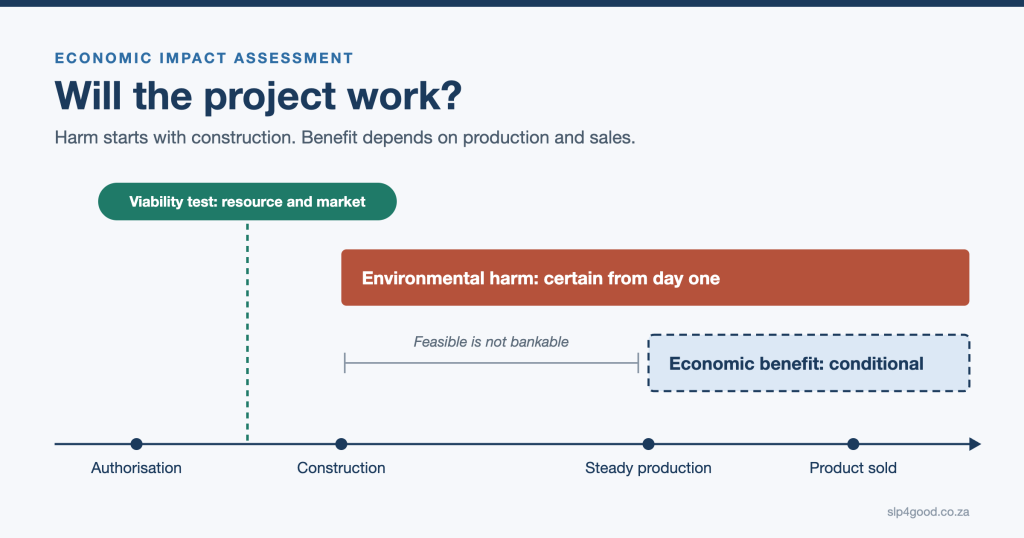
Will the project work? Economic viability as a test in economic impact assessment
How economic impact assessment takes the numbers as given
For most of my career, economic impact assessment in South Africa has taken the applicant’s business case as given. The assessor receives the capital budget, the employment figures and the production profile, runs them through multipliers, and reports the jobs, value added and taxes the project will create. I did this for years, and I believe most of the industry still does.
The question economic impact assessment did not ask was whether the project would work. I do not mean whether it shows a profit on paper, but whether the resource will deliver what the plan assumes and whether anyone has committed to buy the product. Viability was treated as the developer’s business and the lender’s concern, not the assessor’s.
In a recent assessment I could not leave that question alone. The application rested on a feasibility study, not a bankable feasibility study, and the evidence of deliverability and offtake was thin. Every benefit in my economic impact assessment depended on assumptions I could not verify. I wrestled with it for months, and this post sets out where I landed and why.
Why viability belongs in economic impact assessment
The legal basis was there all along. Section 24 of the Constitution protects the environment through ecologically sustainable development while promoting justifiable economic and social development. NEMA section 2(4)(i) requires that the social, economic and environmental impacts of an activity be considered, assessed and evaluated, and section 2(4)(a)(vii) calls for a risk-averse and cautious approach that takes into account the limits of current knowledge.
In Fuel Retailers (2007) the Constitutional Court held that NEMA requires authorities to treat socio-economic factors as an integral part of their environmental responsibility. The case concerned a filling station, and the Court warned that, were it otherwise, “the earth would become a graveyard for commercially failed developments”. A development that fails commercially does not take its environmental footprint with it.
The Department’s 2017 Guideline on Need and Desirability makes the same point in planning terms. The financial viability of a development shows whether it can be done, while need and desirability is the broader question. Neither NEMA nor the guideline uses the word bankable, but an economic impact assessment that reports benefits without asking whether they are attainable has not done what the law asks.
Feasible is not bankable
A feasibility study shows that a project could work. A bankable feasibility study shows, to a standard a lender will rely on, that it will work: the resource is proven, the costs are firm and the buyers are committed. The gap between the two is where the risk lies, and in the industry it is closed by a lender doing its own due diligence.
The environmental authorisation is often granted before that gap closes. The disturbance starts with construction: land is cleared, roads are built, water is drawn and communities start to expect work. The benefits arrive only if the project reaches steady production and sells its product.
Harm is close to certain from the first day, and benefit is conditional. An economic impact assessment that weighs certain harm against conditional benefit as if both were certain overstates the case for approval.
In the case I worked on, the resource had been assessed independently, but whether it would deliver at the rate the plan assumed had not. No buyer had signed, and market development was to follow the authorisation. I accepted the applicant’s information in good faith, but I could not call the project economically sustainable without independent verification.
What I recommended
I did not recommend refusal. I recommended a condition: before full development proceeds, an independent competent person from an established firm must certify that the resource can deliver at the rate the plan assumes, and that there is a market for the product. For the market test, letters of intent from prospective buyers are sufficient, and signed offtake agreements are not required at that stage.
The competent person may also propose an interim stage, limited to what has already been authorised or tested, so that the project proves itself before the full footprint is committed. One environmental application covers the whole development, but the economics are staged through conditions.
I was careful about my own limits. I am not a competent person in the technical discipline concerned, and the technical judgement rests with someone who is. My role was to show the gap between what the economic impact assessment assumed and what the evidence supported, and to recommend how the authority could close it before the disturbance begins.
“Is this a legal requirement?”
The review came back with the question I expected. Several of my recommendations went beyond what the law prescribes, and that was deliberate. The question misses the first principle: economic considerations are integral to environmental law, and the Constitutional Court has said so. An assessor who limits mitigation to the legal minimum is doing compliance, not assessment.
I did draw a line in the end. Measures that rest on the law go into the environmental management programme at the level of the law and no further. Measures that go beyond it become best-practice recommendations outside the programme, for the authority and the applicant to weigh.
The verification of deliverability and market stayed in, because without it the economic case is an assumption. The position caused friction, and I understand why: evidence of viability costs time and money at the point the applicant least wants to spend either. But an economic impact assessment that publishes confident numbers on an unsigned offtake will not hold up on appeal, and it does not serve the applicant either.
What economic impact assessment should change
I believe economic impact assessment should change its default. The first question should be whether the project will work, and the evidence should be in proportion to the footprint the applicant asks the authority to approve. Where the evidence is a feasibility study rather than a bankable one, the assessment should say so and recommend conditions that close the gap before the disturbance starts.
For practitioners, this means reading the business case as critically as we apply the multipliers. For competent authorities, it means treating an unverified economic case as a risk, not a benefit. For applicants, it means accepting that verification costs less before construction than a failed project costs after it.
I would like to hear from other practitioners who have applied a viability test in economic impact assessment, and how authorities received it.
Gerrie Muller · 28 October 2026
References
- Constitution of the Republic of South Africa, 1996, section 24.
- National Environmental Management Act 107 of 1998, sections 2(4)(a)(vii) and 2(4)(i).
- Fuel Retailers Association of Southern Africa v Director-General: Environmental Management, Department of Agriculture, Conservation and Environment, Mpumalanga Province and Others [2007] ZACC 13; 2007 (6) SA 4 (CC).
- Department of Environmental Affairs (2017) Guideline on Need and Desirability, Integrated Environmental Management Guideline Series.
Data sources for economic impact assessment
- Statistics South Africa: Supply and Use Tables, the national accounts base for multipliers.
- South African Reserve Bank: Quarterly Bulletin, for macroeconomic, interest rate and exchange rate assumptions.
- South African Reserve Bank: Online Statistical Query, for the time series behind the Quarterly Bulletin.
- Quantec EasyData: Economic Impact Analysis, for national and regional impact tables and multipliers.
- SAMCODES Standards Committee: SAMREC Code, for reporting mineral resources and reserves, and the role of the competent person.
- Department of Forestry, Fisheries and the Environment, for environmental authorisation guidelines.