Category Archives: Uncategorised

New South African Artisanal and Small Scale Mining policy proposals by DMRE 2022

The Mineral and Petroleum Resources Development Act (MPRDA) is a South African law that regulates the mining industry in the country. In 2022, the MPRDA was amended to include an Artisanal and Small-Scale Mining (ASM) policy.

The ASM policy aims to promote responsible and sustainable mining practices among artisanal and small-scale miners, who are often marginalized and operate outside of the formal mining sector. The policy provides guidelines for the formalization of ASM activities, the allocation of mining rights, the management of environmental impacts, and the support of social and economic development in mining communities.

The policy emphasizes the importance of involving local communities and stakeholders in the development of ASM activities, and requires ASM operators to obtain the necessary permits and licenses, comply with environmental regulations, and adhere to social and labor standards.

The ASM policy is expected to promote the development of a more inclusive and sustainable mining sector in South Africa, while addressing the challenges and risks associated with informal ASM activities.

The policy defines artisanal and small-scale mining as mining activities that are carried out with minimal or no mechanization, using rudimentary methods and tools. Artisanal and small-scale mining typically involves low levels of investment and is often conducted by individuals or small groups, without formal mining titles or permits.

The policy recognizes the potential of ASM to contribute to local development and poverty alleviation, as well as to the country’s mineral wealth. However, it also acknowledges that ASM can have negative impacts on the environment, human health, and safety, and can lead to social conflict and human rights abuses.

To address these challenges, the policy sets out a number of principles and strategies for the formalization and regulation of ASM activities. These include:

  • Encouraging the formalization of ASM activities through the allocation of mining rights and the provision of support services to small-scale miners.
  • Promoting compliance with environmental regulations and standards, and encouraging the adoption of sustainable mining practices.
  • Strengthening the capacity of government institutions to regulate and monitor ASM activities, and to provide support services to small-scale miners.
  • Promoting social and economic development in mining communities, including through the provision of training and skills development programs, access to finance, and the development of local value chains.
  • Ensuring that ASM activities are carried out in a manner that respects human rights and labor standards, and that protects the health and safety of workers and local communities.

The policy also recognizes the importance of involving local communities and stakeholders in the development of ASM activities, and provides for the establishment of local committees and forums to facilitate dialogue and consultation.

Overall, the ASM policy represents an important step towards the formalization and regulation of artisanal and small-scale mining in South Africa, and towards the promotion of responsible and sustainable mining practices that benefit local communities and the country as a whole.

5 Critical elements of a LED project in the Social and Labour plan

Here are the five critical components most requested by the DMRE when it comes to LED planning:

  1. It must be shown that the LED Project will be sustainable, and this must be outlined in the LED project plan as provided by the DMRE.
  2. Stakeholder roles in the LED project must be clearly stated and agreements need to be signed between the parties involved on the project.
  3. Evidence must be presented that the mine had consulted with the local municipality to align the LED project to the local IDP.
  4. The ownership of the facility where the LED development is situated must be indicated and proof of the security of premises must be provided.
  5. The mine’s exit strategy to the project must be clearly described.

Equity equivalent benefit to communities

2.1.4.1 The equity equivalent benefit referred to in paragraph 2.1.3.2 (ii) shall be administered as follows:

2.1.4.1.1 5% equivalent of the issued share capital of the mining right holder, at no cost to a trust or similar vehicle set up for the benefit of host communities;

2.1.4.1.2 The Trust or similar vehicle shall be established and administered in terms of applicable legislation for the duration of the mining right;

2.1.4.1.3 The Trust or similar vehicle shall comprise of representation from host communities (including Community Based Organisations, Traditional Authorities, etc.) and mining companies;

2.1.4.1.4 A mining right holder must, in consultation with relevant municipalities, host communities, traditional authorities and affected stakeholders; identify host community development needs;

2.1.4.1.5 The Trust or similar vehicle shall be responsible for, amongst others, host community development programme, fund distribution and governance of the equity equivalent benefit;

2.1.4.1.6 All administration costs, project management and consultation fees of the Trust or similar vehicle may not exceed 8% of the total budget;

2.1.4.1.7 An approved host community development programme must be published in, at least, two languages commonly used within the host community.

2.1.4.2 A host community development programme approved under this element shall not replace Social and Labour Plan commitments as contemplated in Section 23 of the MPRDA.

Mining Charter Transitional Arrangement

By March this year your new SLP strategies to conform with Mining Charter III needs to be in!

See para 8 of Mining Charter III below.

8. TRANSITIONAL ARRANGEMENTS

A mining right holder must progressively align existing targets from the Mining Charter, 2010 targets within the transitional period, to meet the revised requirements as follows:

8.1 Five (5) years for the inclusive procurement element. A mining right holder must within six (6) months from the date of publication of the Mining Charter, 2018 submit a five – year plan indicating progressive implementation of inclusive procurement targets.

8.2 Compliance with procurement targets within the transitional period shall be as follows:

8.2.1 Mining Goods: The first -year target is set at 10% of the procurement budget, second year 20% of the procurement budget, 35% of the procurement budget by third year, 50% of the procurement budget by fourth year and 70% of the procurement budget by fifth year.

8.2.2 Services: The first -year target is set at 70% of the procurement budget, second year 80% of the procurement budget.

8.2.3 The use of coding system for verification of local content shall be applicable once finalised by the Department of Trade and Industry.

8.3 Five (5) years for the Employment Equity element. A mining right holder must within a period of six (6) months from the date of publication of the Mining Charter, 2018 submit a five -year plan indicating progressive implementation of the provisions of Employment Equity element targets.

8.4 A mining right holder must comply with the Housing and Living Conditions Standard and ensure that it maintains single units, family units and any other arrangements agreed to with employees, pending the finalisation of the Reviewed Housing and Living Conditions Standard.

8.5 At the end of the transition period, a mining right holder must comply with the Mining Charter, 2018 targets as provided for in the respective elements.

8.6 A mining right holder’s performance shall be reported, audited and verified annually against each element in respect of implementation for the applicable transitional

How does one give 5% of your mining shares to a community?

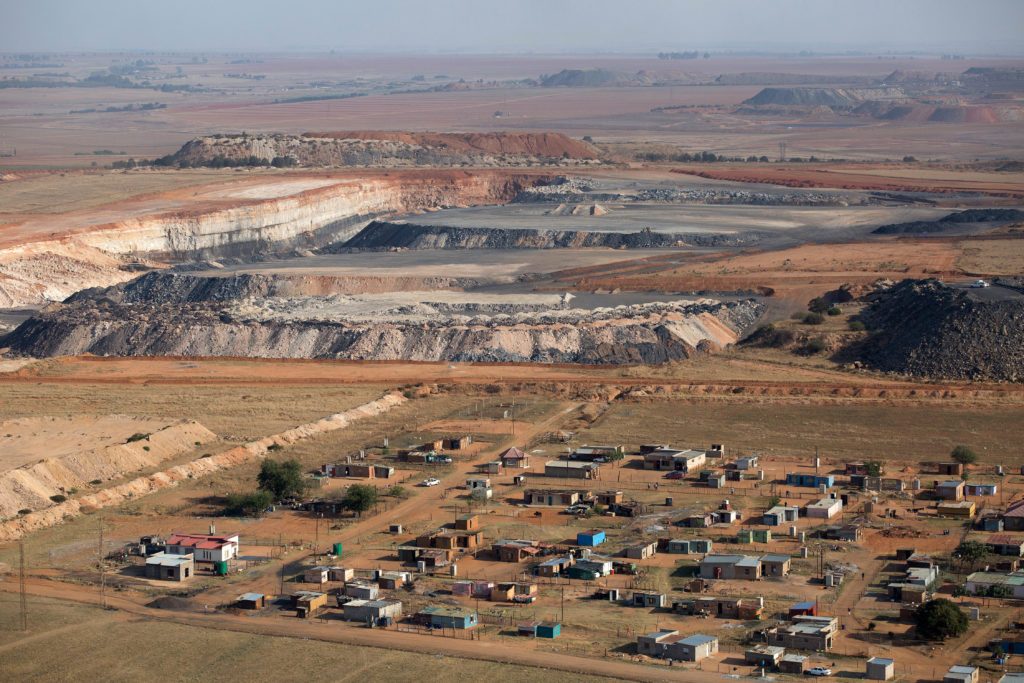
September 24, 2016. Arbor. Coal mining Mpumalanga. Picture: JAMES OATWAY for CER

How does one give 5% of your mining shares to a mining community?

There are many new provisions in Mining Charter III and one of them has to do with the gifting of 5% shares to the community and 5% to employees. The latter is easy because ESOP’s are pretty standard. The logic aside, the criticisms aside, how does one administer 5% free equity to a community?

There is quite a good example of Kumba in Kathu where they had set up a Community Trust and by all accounts this is a success story.  This trust has many investments in the local area. But, to some extend that was simple, because Kathu is none other than a Kumba mining town.

Now let’s take the hundreds of sand and aggregate mines that are dotted in more metropolitan areas. How will they identify their communities? Or let’s take the case of a Burgersfort area where there must be at least 10 mining right holders. How would they do it?

On the one level, one could say, keep it simple. On another level, it’s never going to be simple. My experience of local communities is that they are often very divided, and that to achieve that broad-based consensus amongst all members will take time.

No to mention the legal and administrative costs of setting up Trusts and SPV’s to enact this.

Alas, solutions we must find.